


 021-51111890
 购物车()
购物车()
 sales@molnova.cn







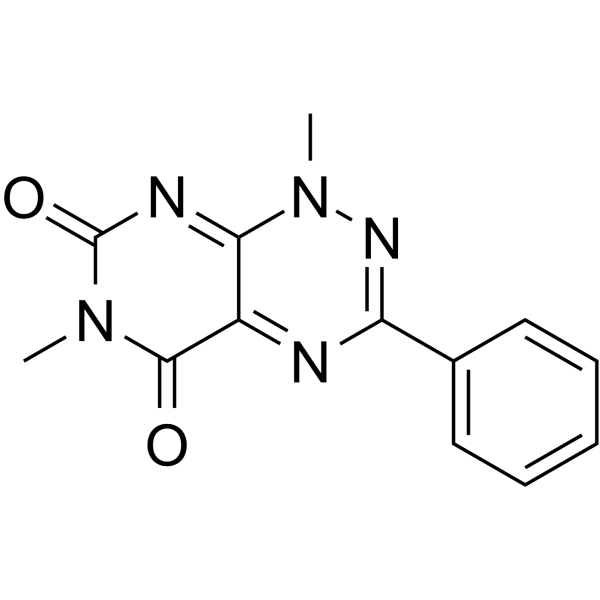
3-Phenyltoxoflavin
CAS No. 32502-63-9
3-Phenyltoxoflavin ( ZINC267655 | Phenyltoxoflavin )
产品货号. M28065 CAS No. 32502-63-9
3-Phenyltoxoflavin 是 HSP90 的抑制剂 (Kd = 585 nM),具有抗癌活性。
纯度: >98% (HPLC)
 COA
Datasheet
HNMR
HPLC
MSDS
Handing Instructions
COA
Datasheet
HNMR
HPLC
MSDS
Handing Instructions
| 规格 | 价格/人民币 | 库存 | 数量 |
| 5MG | ¥1121 | 有现货 |


|
| 10MG | ¥1891 | 有现货 |
|
| 25MG | ¥3143 | 有现货 |
|
| 50MG | ¥4492 | 有现货 |
|
| 100MG | ¥6057 | 有现货 |
|
| 200MG | ¥8001 | 有现货 |
|
| 500MG | 获取报价 | 有现货 |
|
| 1G | 获取报价 | 有现货 |
|
| 1 mL x 10 mM in DMSO | ¥1292 | 有现货 |
|
生物学信息
-
产品名称3-Phenyltoxoflavin
-
注意事项本公司产品仅用于科研实验,不得用于人体或动物的临床与诊断
-
产品简述3-Phenyltoxoflavin 是 HSP90 的抑制剂 (Kd = 585 nM),具有抗癌活性。
-
产品描述3-Phenyltoxoflavin is an inhibitor of HSP90 (Kd = 585 nM) with anti-cancer activity.(In Vitro):3-Phenyltoxoflavin (0.56 nM-100 μM) dose-dependently competes with biotinylated Hsp90 peptide for binding to TPR2A. In BT474 cells, 3-Phenyltoxoflavin (1 nM-100 μM) dose-dependently inhibits cell proliferation with an IC50 of 690 nM.
-
体外实验3-Phenyltoxoflavin (1 nM-100 μM; 4 d) inhibits BT474 cells proliferation in a concentration-dependent manner, with an IC50 of 690 nM.3-Phenyltoxoflavin (0.56 nM-100 μM; 2 h) competes with biotinylated Hsp90 peptide for its binding to TPR2A in a dose-dependent manner.
-
体内实验——
-
同义词ZINC267655 | Phenyltoxoflavin
-
通路Cytoskeleton/Cell Adhesion Molecules
-
靶点HSP
-
受体——
-
研究领域——
-
适应症——
化学信息
-
CAS Number32502-63-9
-
分子量269.26
-
分子式C13H11N5O2
-
纯度>98% (HPLC)
-
溶解度In Vitro:?DMSO : 7.14 mg/mL (26.52 mM)
-
SMILESO=C1N=C2C(=NC(=NN2C)C3=CC=CC=C3)C(=O)N1C
-
化学全称——
运输与储存
-
储存条件(-20℃)
-
运输条件With Ice Pack
-
稳定性≥ 2 years
参考文献
1.Ajeet. QSAR Study of Methionine Aminopeptidase Inhibitors as Anti-cancer Agents Using MLR Approach[J]. american journal of pharmacological sciences. 2013;1(5):80-83, 4 pp.
产品手册


关联产品
-
Geldanamycin
Geldanamycin 是一种天然存在的 HSP90 抑制剂,Kd 为 1.2 μM,特异性破坏糖皮质激素受体 (GR)/HSP 关联。
-
Hsp70-derived octape...
A group of tetratricopeptide repeat (TPR)-containing proteins has been shown to interact with the C-terminal domain of the 70 kDa heat-shock cognate protein (hsc70). In the present study, the effect of the TPR-containing proteins, including the C-terminus of hsc70-interacting protein (CHIP), TPR1 and human glutamine-rich TPR-containing protein (hSGT), on refolding of luciferase by DnaJ and hsc70 was investigated.
-
Feretoside
Feretoside 是从 E. ulmoides 的树皮中提取的天然产物。 Feretoside 对热休克因子 1 (HSF1) 显示诱导活性。