


 021-51111890
 购物车()
购物车()
 sales@molnova.cn







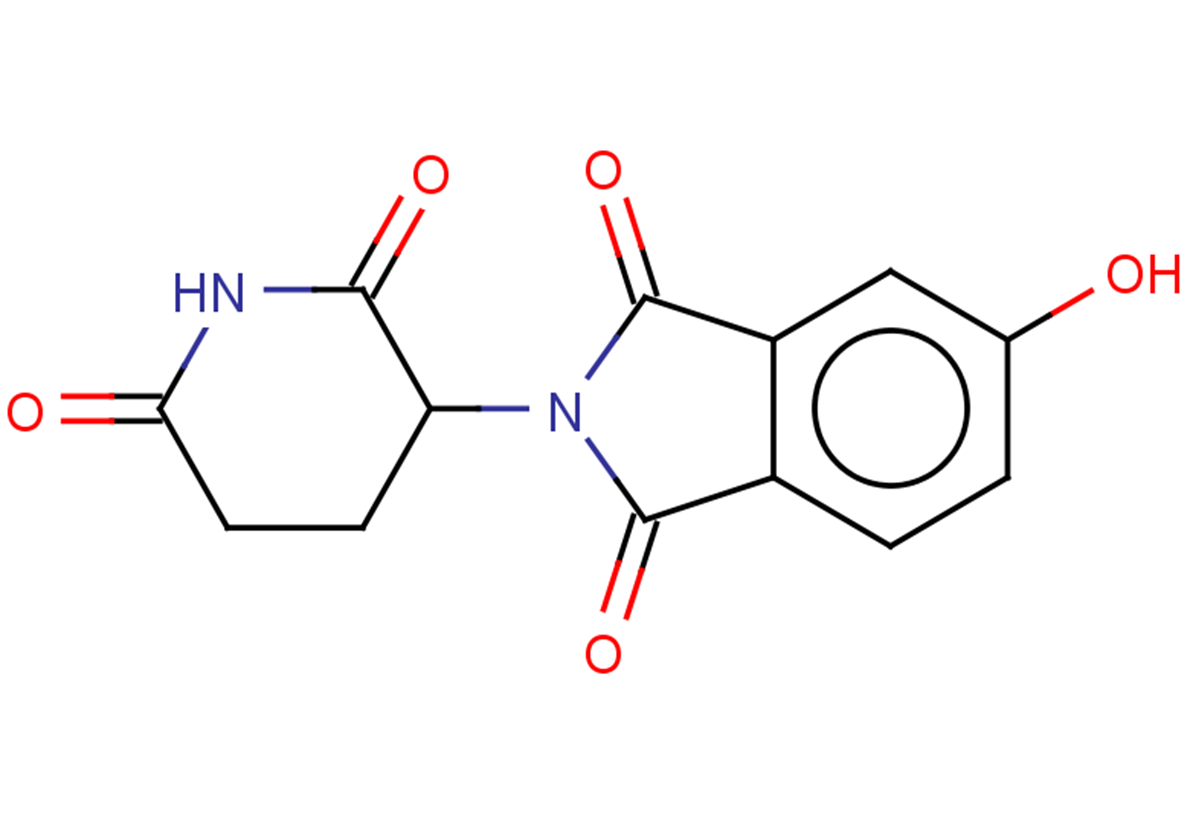
Thalidomide-5-OH
CAS No. 64567-60-8
Thalidomide-5-OH ( —— )
产品货号. M24660 CAS No. 64567-60-8
Thalidomide-5-OH 是基于 Thalidomide 的 cereblon 配体,用于招募 CRBN 蛋白。它可以通过连接子与蛋白质的配体连接,形成PROTAC。
纯度: >98% (HPLC)
 COA
Datasheet
HNMR
HPLC
MSDS
Handing Instructions
COA
Datasheet
HNMR
HPLC
MSDS
Handing Instructions
| 规格 | 价格/人民币 | 库存 | 数量 |
| 500MG | ¥97 | 有现货 |


|
| 1G | 获取报价 | 有现货 |
|
| 1 mL x 10 mM in DMSO | ¥103 | 有现货 |
|
生物学信息
-
产品名称Thalidomide-5-OH
-
注意事项本公司产品仅用于科研实验,不得用于人体或动物的临床与诊断
-
产品简述Thalidomide-5-OH 是基于 Thalidomide 的 cereblon 配体,用于招募 CRBN 蛋白。它可以通过连接子与蛋白质的配体连接,形成PROTAC。
-
产品描述Thalidomide-5-OH is the Thalidomide-based cereblon ligand that used in the recruitment of CRBN protein. It can be connected to the ligand for protein by a linker to form PROTAC.
-
体外实验——
-
体内实验——
-
同义词——
-
通路Others
-
靶点Other Targets
-
受体Others
-
研究领域——
-
适应症——
化学信息
-
CAS Number64567-60-8
-
分子量274.23
-
分子式C13H10N2O5
-
纯度>98% (HPLC)
-
溶解度DMSO : 60 mg/mL (218.80 mM; Need ultrasonic)
-
SMILESOc(cc1)cc(C(N2C(CCC(N3)=O)C3=O)=O)c1C2=O
-
化学全称——
运输与储存
-
储存条件(-20℃)
-
运输条件With Ice Pack
-
稳定性≥ 2 years
参考文献
1.Megan G Marks, et al. Effects of Putative Hydroxylated Thalidomide Metabolites on Blood Vessel Density in the Chorioallantoic Membrane (CAM) Assay and on Tumor and Endothelial Cell Proliferation. Biol Pharm Bull. 2002 May;25(5):597-604.
产品手册


关联产品
-
Cyanidin3-(6-(2-(E)-...
Cyanidin3-(6-(2-(E)-sinapoyl-β-D-glucopyranosyl)-β-D-glucopyranosyl)-5-(6-(E)-sinapoyl)-β-D-glucopyranoside
-
Cinnamylideneacetic ...
JUAREZIC ACID 也称为 5-Phenylpenta-2, 4-dienoic Acid。
-
2-heptyl-3-hydroxy-4...
2-heptyl-3-hydroxy-4(1H)-Quinolone (Pseudomonas Quinolone Signal) is a quorum-sensing signalling molecule produced by Pseudomonas aeruginosa in response to increased cell density. It increases the expression of the lasB gene in P. aeruginosa, the secretion of the metabolites pyocyanin and the lectin PA-IL, as well as increasing biofilm production in P. aeruginosa populations. It also reduces the iron content of the P. aeruginosa growth medium when used at a concentration of 40 μM and acts as an iron chelator in iron sulphate solutions.