


 021-51111890
 购物车()
 sales@molnova.cn







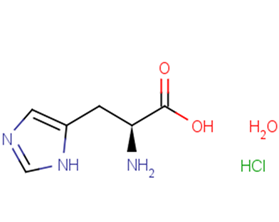
L-Histidine monohydrochloride monohydrat
CAS No. 5934-29-2
L-Histidine monohydrochloride monohydrat ( —— )
产品货号. M19639 CAS No. 5934-29-2
组氨酸(缩写为 His 或 H)是一种 α-氨基酸。 L-异构体是 22 种蛋白氨基酸之一,即蛋白质的组成部分。
纯度: >98% (HPLC)
 COA
Datasheet
HNMR
HPLC
MSDS
Handing Instructions
| 规格 | 价格/人民币 | 库存 | 数量 |
| 500MG | ¥147 | 有现货 |


|
| 1G | 获取报价 | 有现货 |
|
生物学信息
-
产品名称L-Histidine monohydrochloride monohydrat
-
注意事项本公司产品仅用于科研实验,不得用于人体或动物的临床与诊断
-
产品简述组氨酸(缩写为 His 或 H)是一种 α-氨基酸。 L-异构体是 22 种蛋白氨基酸之一,即蛋白质的组成部分。
-
产品描述Histidine (abbreviated as His or H) is an alpha-amino acid. The L-isomer is one of the 22 proteinogenic amino acids i.e. the building blocks of proteins. It is classified as a charged polar because of the hydrophilic nature of the imidazole side chain. L-Histidine is a positively charged (pKa 6.5) aromatic amino acid. Histidine residues are often found in enzyme active sites where the chemistry of the imidazole ring of histidine makes it a nucleophile and a good acid/base catalyzer. Histidine is special in that its biosynthesis is inherently linked to the pathways of nucleotide formation. In the first step of histidine synthesis PRPP (5-phosphoribosyl-alpha-pyrophosphate) condenses with ATP to form a purine N1-5'-phosphoribosyl ATP in a reaction that is driven by the subsequent hydrolysis of the pyrophosphate that condenses out. Glutamine plays a role as an amino group donor resulting in the formation of 5-aminoamidazole-4-carboximide ribonucleotide (ACAIR) which is an intermediate in purine biosynthesis. Hisitidne is catabolized by the enzyme histidine ammonia-lyase which converts histidine into ammonia and urocanic acid.
-
体外实验——
-
体内实验——
-
同义词——
-
通路Others
-
靶点Other Targets
-
受体Others
-
研究领域Others
-
适应症accessory substance
化学信息
-
CAS Number5934-29-2
-
分子量209.63
-
分子式C6H12ClN3O3
-
纯度>98% (HPLC)
-
溶解度DMSO:10 mM
-
SMILESO.Cl.N[C@@H](Cc1cnc[nH]1)C(O)=O
-
化学全称——
运输与储存
-
储存条件(-20℃)
-
运输条件With Ice Pack
-
稳定性≥ 2 years
参考文献
1.De?Sousa G.P. Freire P.T.C. Filho J.M. et al. Braz J Phys (2013) 43: 137. https://doi.org/10.1007/s13538-013-0132-3
产品手册



关联产品
-
L-655708
L-655708 是有效的, 选择性 GABAA 受体反向激动剂 (Ki=0.45 nM)。
-
Thymine
胸腺嘧啶存在于核酸DNA中。在大多数情况下,RNA 中的胸腺嘧啶被尿嘧啶取代。在 DNA 中,胸腺嘧啶通过两个氢键与腺嘌呤结合,有助于稳定核酸结构。
-
(±)8(9)-EpETE
Eicosapentaenoic acid is converted to epoxyeicosatetraenoic acids (EpETEs) by several cytochrome P450 isoforms. The major product of this epoxygenase pathway, (±)17(18)-EpETE , relaxes vascular and airway smooth muscle by activating large conductance Ca2+-activated K+ (BKCa) channels by directly interacting with BKα channel subunits. (±)8(9)-EpETE is an epoxygenase pathway product produced from EPA by CYP450 both in vitro and in vivo. The biological actions and physiological effects of this epoxide remain to be determined.