


 021-51111890
 购物车()
购物车()
 sales@molnova.cn







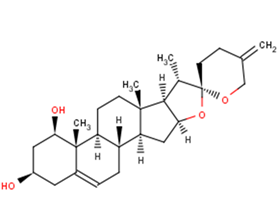
Neoruscogenin
CAS No. 17676-33-4
Neoruscogenin ( —— )
产品货号. M18130 CAS No. 17676-33-4
Neoruscogenin 因其相对于其他核受体的特定选择性而成为 RORα 研究的通用药理学工具。
纯度: >98% (HPLC)
 COA
Datasheet
HNMR
HPLC
MSDS
Handing Instructions
COA
Datasheet
HNMR
HPLC
MSDS
Handing Instructions
| 规格 | 价格/人民币 | 库存 | 数量 |
| 5MG | ¥1159 | 有现货 |


|
| 10MG | ¥1824 | 有现货 |
|
| 25MG | ¥3041 | 有现货 |
|
| 50MG | ¥4613 | 有现货 |
|
| 100MG | ¥6174 | 有现货 |
|
| 500MG | 获取报价 | 有现货 |
|
| 1G | 获取报价 | 有现货 |
|
| 1 mL x 10 mM in DMSO | ¥1264 | 有现货 |
|
生物学信息
-
产品名称Neoruscogenin
-
注意事项本公司产品仅用于科研实验,不得用于人体或动物的临床与诊断
-
产品简述Neoruscogenin 因其相对于其他核受体的特定选择性而成为 RORα 研究的通用药理学工具。
-
产品描述Neoruscogenin represents a universal pharmacological tool for RORα research due to its specific selectivity profile versus other nuclear receptors.
-
体外实验Western Blot Analysis Cell Line:C2C12 myoblasts Concentration:0.1 μM Incubation Time:5 days Result:Increased protein expression of MyHC and MyOG at 0.1 μM, but did not work as well as 0.1 μM at 5 and 10 μM
-
体内实验Animal Model:male ICR mice Dosage:1 mg/kg Administration:i.p.Result:Showd the larger size of TA muscles, and increasaed the weight of Gas muscles.Showed visible myofibers hypertrophy (H&E staining).
-
同义词——
-
通路Others
-
靶点Other Targets
-
受体Others
-
研究领域——
-
适应症——
化学信息
-
CAS Number17676-33-4
-
分子量428.61
-
分子式C27H40O4
-
纯度>98% (HPLC)
-
溶解度In Vitro:?DMSO : 50 mg/mL (116.66 mM)
-
SMILESC[C@]12CC[C@H]([C@@](C)([C@H](O)C[C@H](O)C3)C3=CC4)[C@@H]4[C@@H]1C[C@H]5[C@@H]2[C@H](C)[C@](O5)(CC6)OCC6=C
-
化学全称——
运输与储存
-
储存条件(-20℃)
-
运输条件With Ice Pack
-
稳定性≥ 2 years
参考文献
产品手册




关联产品
-
4-IPP
4-IPP 是巨噬细胞迁移抑制因子 (MIF) 的不可逆抑制剂。
-
3,8'-Biapigenin
3, 8''-Biapigenin can modulate intracellular ROS production.
-
γ-2-MSH (41-58), ami...
Melanocortin (MC) 3-MSH (Melanocyte-Stimulating Hormone) is believed to signal through the MC 3 receptor. It induces a sustained increase in intracellular free calcium levels ([Ca2+]i) in a subpopulation of pituitary cells. Most of the cells responding to 3-MSH express more than one pituitary hormone mRNA. The effect of 3-MSH is blocked by SHU9119, a MC3R and MC4R antagonist, in only 50% of the responsive cells, suggesting that in half of these cells the mediating receptor is not the MC3R. Low picomolar doses of 3-MSH increase [Ca2+]i in the growth hormone (GH)- and prolactin (PRL)-secreting GH3 cell line.